In 2026, open world games continue to dominate the gaming landscape, but truly innovative traversal mechanics remain a rare gem. 🗺️ While many titles stick to the familiar formula of walking, running, and vehicle use, a select few have pushed the boundaries, offering players lightning-fast and creatively engaging ways to explore their vast digital landscapes. These games ditch conventional transportation, empowering players with supernatural abilities, high-tech gadgets, or a unique blend of parkour and magic to redefine movement itself. Forget long, tedious commutes across the map; in these worlds, the journey becomes an exhilarating spectacle of speed and style. Let's dive into the games that make getting from point A to point B the main event.
🕸️ Marvel's Spider-Man 2: Web-Swinging & Wingsuit Mastery
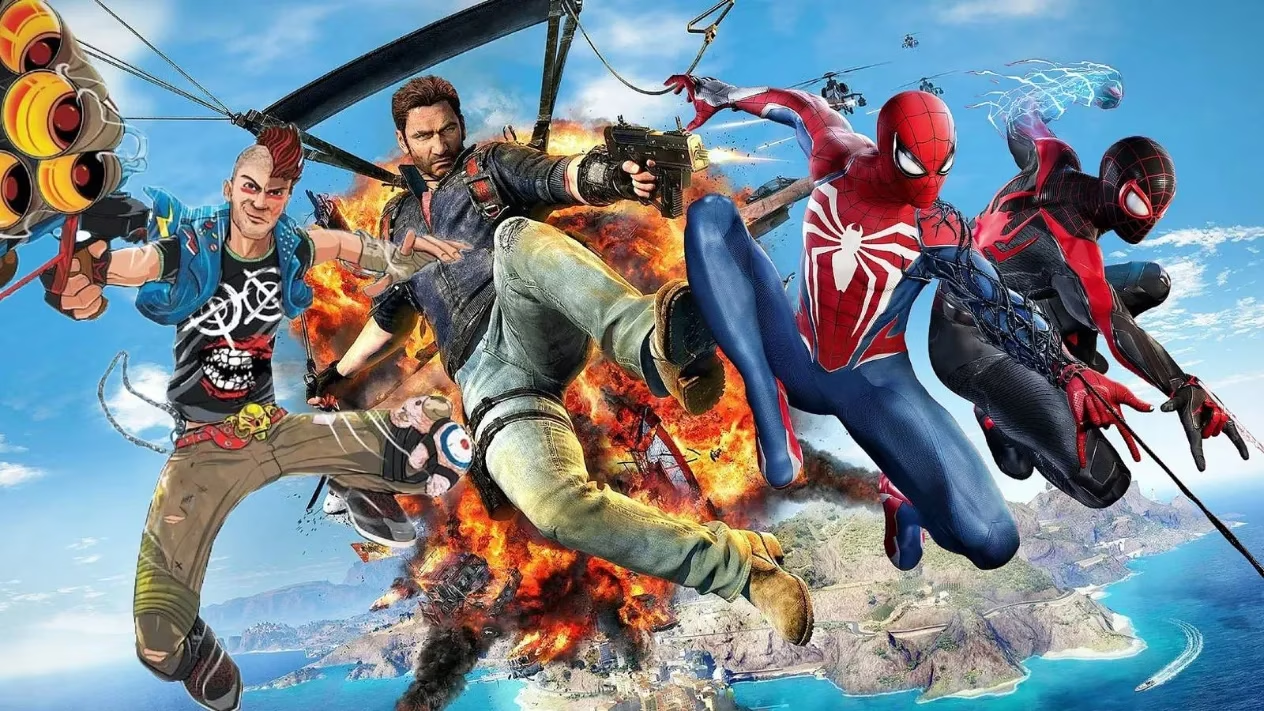
The sequel to the beloved Spider-Man series took traversal to new heights—literally. Both Peter Parker and Miles Morales can now utilize high-tech wingsuits alongside their iconic web-swinging. This combination allows players to cross the sprawling recreation of New York City in mere minutes, creating a sense of unparalleled speed and freedom. The wingsuit is particularly useful in high-speed chase sequences, adding a thrilling new layer to navigation.
However, this incredible speed came with an unexpected consequence. Some dedicated players felt the unrestricted use of the wingsuit made traversal too fast, paradoxically reducing engagement with the beautifully crafted city. Many recommend embracing the classic web-swinging mechanics for a more immersive and enjoyable experience. The fluid animations, the satisfying thwip of webs, and the ability to interact dynamically with skyscrapers and cityscapes offer a rhythmic and deeply satisfying traversal method that the wingsuit simply can't match.
🪂 Just Cause 3: The Grappling Hook & Wingsuit Revolution
This entry in the explosive Just Cause series is often hailed for perfecting the formula of chaotic fun. Protagonist Rico Rodriguez has access to vehicles, but they quickly become obsolete thanks to his game-changing gear: a grappling hook and a wingsuit. By mastering the synergy between these two tools, players can achieve movement that rivals Spider-Man himself, often traversing entire islands without ever touching the ground.
The key to mastery is using the grappling hook to latch onto any surface—buildings, moving cars, even planes mid-flight—and then deploying the wingsuit to maintain momentum and glide vast distances. This system offers an incredible sense of flexibility and raw speed that few games, even years later, have managed to replicate. The seamless transition from hook to flight creates a uniquely empowering and fast-paced exploration loop.
🛹 Sunset Overdrive: Grinding, Zipping, and Bouncing Through Chaos
In a world overrun by mutants, your best weapon is style. Sunset Overdrive features one of the most distinctive and skill-based traversal systems ever designed. Entirely forgoing traditional vehicles, the game encourages players to "grind" on almost any surface—power lines, railings, rooftops—combining this core move with wall-runs, zip-lines, and using city objects as bounce pads.
What sets it apart is its demand for player skill. Successfully navigating the city at top speed isn't about holding a button; it's about chaining moves together fluidly, reading the environment, and maintaining momentum. Even water becomes a traversal tool, allowing for slick surface slides or explosive dive-and-rise maneuvers to gain speed. It’s a system that rewards creativity and practice, making every journey a thrilling acrobatic performance.
💨 inFAMOUS: Second Son: Elemental Parkour with Style
Delsin Rowe's journey through Seattle is supercharged by his ability to absorb and wield different elemental powers. While not the absolute fastest on this list, Second Son offers a wonderfully creative and visually stunning mix of parkour and supernatural abilities. His Smoke and Neon powers transform standard movement into a spectacular display.
Players can perform supernatural sprints, launch into massive jumps, and glide across districts. The Neon power, in particular, allows Delsin to dash at incredible speeds along power lines and literally run up the sides of buildings. The traversal is deeply integrated with the environment, such as using ventilation shafts to rocket to rooftops. Every move is accompanied by dazzling particle effects, making fast travel a breathtaking visual feast.
🦸 Saints Row IV: Superpowers in a Virtual Playground
Where Saints Row fully embraced the absurd, it gave players one of the most liberating movement kits in gaming. Set inside a virtual simulation, the player character gains overpowered superpowers that make vehicles completely redundant. The suite includes blistering super-speed sprints, colossal leaps that launch you over city blocks, and a seamless glide that eventually unlocks into full, unrestricted flight.
This last point is crucial: Saints Row IV remains one of the very few open-world games that grants true, free-form flight. Not gliding, not limited hovering, but honest-to-goodness Superman-style flying anywhere on the map. This power fundamentally changes how players interact with the world, encouraging vertical exploration and enabling a sheer, joyful sense of omnipotence as you soar above Steelport.
🧬 Prototype 2: Unstoppable Mutant Momentum
As the evolved successor to the original, Prototype 2 delivers raw, biotic-powered speed. The protagonist, James Heller, can sprint up the sides of buildings, perform devastating glide attacks from skyscrapers, and leap across districts in a single bound. The movement is intensely fast and fluid, designed to make the player feel like an unstoppable force of nature.
The trade-off for this raw power is a lack of intricate mechanics. Movement, while incredibly fast, can feel automatic and less skill-based compared to titles like Sunset Overdrive. The developers prioritized empowering, chaotic action over complex traversal challenges. Vehicles are present but feel sluggish and pointless when you can outrun and out-jump anything on the streets of a zombie-infested New York.
🔮 Forspoken: Magic Parkour Across Athia
Despite a mixed reception at launch, Forspoken’s "Magic Parkour" system stands out as a brilliantly original concept. Protagonist Frey Holland uses a diverse set of magical abilities to traverse the vast, hostile land of Athia with incredible grace and speed. Her movement is a flow-based dance of lengthy magical jumps, zip-line-like grapples, unrestricted dash attacks, and even the ability to skid effortlessly across bodies of water.
With no traditional vehicles or mounts, mastery of these magical abilities is essential. Once players unlock and learn to chain her skills, they can flow across the landscape at breathtaking speeds, seamlessly blending traversal with combat. The system encourages experimentation, allowing players to create their own acrobatic combinations for both exploration and engaging the enemy, making every sprint across the plains a potential spectacle.
Final Thoughts: The Need for Speed (and Creativity) 🚀
As we look at the open-world games of 2026 and beyond, the titles that are remembered most fondly are often those that turn travel into a core pleasure. The games listed above prove that movement mechanics are not just a means to an end but a vital part of the gameplay identity and player fantasy. Whether it's the rhythmic swing of a web, the chaotic chaining of grinds and bounces, or the god-like freedom of flight, these creative systems keep players engaged long after the main story ends. They remind us that in a vast open world, the fun should be in the journey, not just the destination.