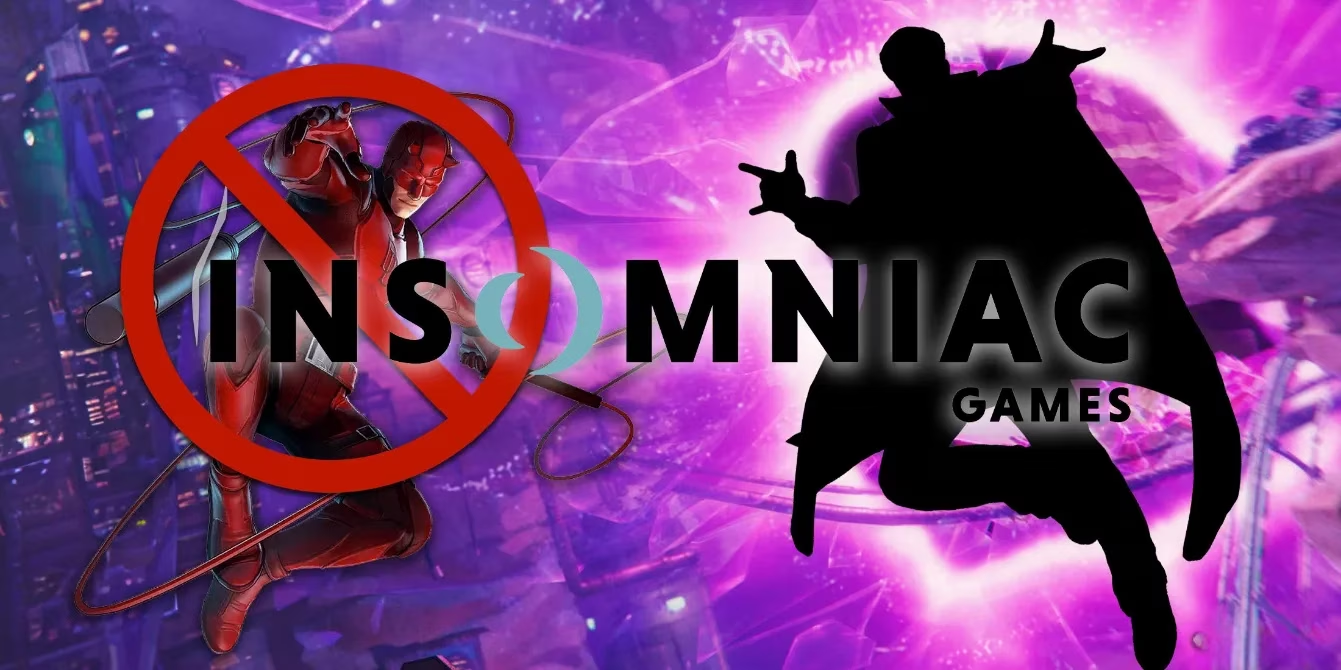
Picture this: a studio that has already perfected the art of web-swinging through New York’s skyline, redefined superhero storytelling, and even toyed with interdimensional portals—suddenly turning its gaze to the Sorcerer Supreme. Insomniac Games has danced with Marvel’s finest, and after two spectacular Spider-Man outings (and a very promising Wolverine on the horizon), the natural next step might be the mind-bending, reality-warping world of Doctor Strange. Given the studio’ .is track record, it’s not just a fan dream—it’s practically a multiversal inevitability.
In 2021, Ratchet & Clank: Rift Apart didn just open a portal—it tore the fabric of gaming boredom apart. The Rift Tether became a wrist-mounted passport to parallel dimensions, yanking players across shattered realities with a single button press. One moment you’d be grappled to a higher ledge, the next you’d land in a world where gravity was merely a suggestion and enemies wore entirely different skins. Insomniac treated dimensional hopping not as a gimmick but as a storytelling instrument, a Swiss Army knife of level design. Think of it as a magician pulling an infinite chain of glowing silk scarves from a sleeve—each portal was a fresh surprise, a new trick waiting to be revealed.
Fast forward to 2025’s Marvel’s Spider-Man 2, and the portal fetish returned in style. During a thrilling chase sequence, Black Cat swiped a mystical artifact from the Sanctum Sanctorum and turned Manhattan into her own personal escape maze. As Miles Morales, players zipped through swirling blue rifts, each one depositing them atop a different rooftop, a different street, a different piece of the puzzle. The sequence lasted only minutes, but it screamed “proof of concept.” Insomniac’s love for portals isn’t just a phase—it’s a signature.
And that’s why a Doctor Strange game feels less like speculation and more like destiny. The MCU’s Sorcerer Supreme wields the Sling Ring, a tool that can open gateways anywhere, anytime. Imagine what Insomniac could do with a dedicated triple-A title built entirely around that mechanic. Traversal wouldn’t be about swinging or wall-running; it would be about slicing through space like a hot knife through butter. Need to reach a floating island in the Dark Dimension? One sling, and you’re there. Cornered by Dormammu’s Mindless Ones? Open a portal behind them and send them tumbling into the Mirror Dimension. Combat would become a ballet of spatial geometry—players could redirect enemy projectiles back through a portal, pull allies from across the map, or even split the battlefield into fragments. It’s like juggling flaming pinwheels while reciting advanced geometry theorems—chaotic, beautiful, and only possible in a Strange game.
Beyond the spectacle, the narrative tone would slot into Insomniac’s wheelhouse like a key into a lock. Over the last decade, the studio has mastered a peculiar cocktail: laugh-out-loud humor floating on top of a deep, emotional espresso shot. The Spider-Man games are built on a foundation of quippy banter and comic-book violence, but underneath that, they’ve tackled identity crises, the cost of heroism, and the pain of watching loved ones turn into villains. It’s a blend as perfectly balanced as a Sorcerer’s tea—frothy and aromatic, but packing a serious kick.
A Doctor Strange game would thrive on that same duality. On one hand, you have a hero who converses with sentient cloaks, argues with books of forbidden knowledge, and explores LSD-inspired dimensions where physics takes a coffee break. The visual humor practically writes itself—imagine a boss battle where Strange has to barter with a giant, eldritch octopus because it holds the key to his next spell. On the other hand, Stephen Strange’s origin story is one of loss, ego death, and the constant struggle to balance the fate of reality against his own humanity. Insomniac could easily pull players into a narrative where every interdimensional loophole comes with a soul-crushing cost, while still letting Wong crack jokes in the background. That’s the Insomniac formula in a nutshell: a smiling mask with tear-streaked cheeks.
Of course, the studio is currently busy. The 2023 ransomware attack spilled the beans on an entire X-Men trilogy, with Marvel’s Wolverine leading the charge. As of 2026, Logan’s solo debut is still living rent-free in fans’ minds, with rumors hinting at a late-year launch. Insomniac has its claws full, and Wolverine will likely set a new benchmark for gritty superhero action. But once the adamantium dust settles, there will still be a mystical chasm left to explore. And who better to fill it than the team that’s already proven they can weave portals into a core gameplay loop without breaking a sweat?
Let’s not forget the potential for co-op or multiplayer wrinkles. Doctor Strange rarely works alone—he’s got the Midnight Sons, the Ancient One’s legacy, and a whole multiverse of allies. A drop-in/drop-out system where a second player controls Clea or a custom sorcerer could elevate the experience. Imagine one player opening a portal while the other hurls a bolt of pure chaos through it, hitting a target a thousand virtual miles away. The synergies would be a feast for streamers and lore nerds alike.
In the end, Insomniac Games doesn’t just make blockbusters—it builds bridges between what gamers love and what they never knew they wanted. A Doctor Strange project would be the ultimate bridge between the studio’s portal obsession and its deep understanding of Marvel’s heart. Whether it arrives in 2028 or 2030, the stars are quietly aligning. The real question isn’t “if” but “when” we’ll see the Sorcerer Supreme step through one of Insomniac’s signature rifts, turning our expectations inside out like a sock in a tornado.
⏳✨ Until then, we’ll keep slinging portals in our daydreams.