Peter Parker’s romantic life in Insomniac’s blockbuster Spider-Man series has been a settled affair. Over the course of Marvel’s Spider-Man, the episodic City That Never Sleeps DLC, Spider-Man: Miles Morales, and Marvel’s Spider-Man 2, the web-slinger’s on-again, off-again relationship with Mary Jane Watson reached a satisfying and seemingly unshakable conclusion. Their bond weathered everything from Peter’s self-sacrificing stubbornness to Felicia Hardy’s mischievous return, and by the end of Marvel’s Spider-Man 2 the couple was firmly building a life together. Miles Morales, meanwhile, found an easy and heartfelt connection with Hailey Cooper, proving that Insomniac’s world is one where romantic stability actually exists for its heroes.
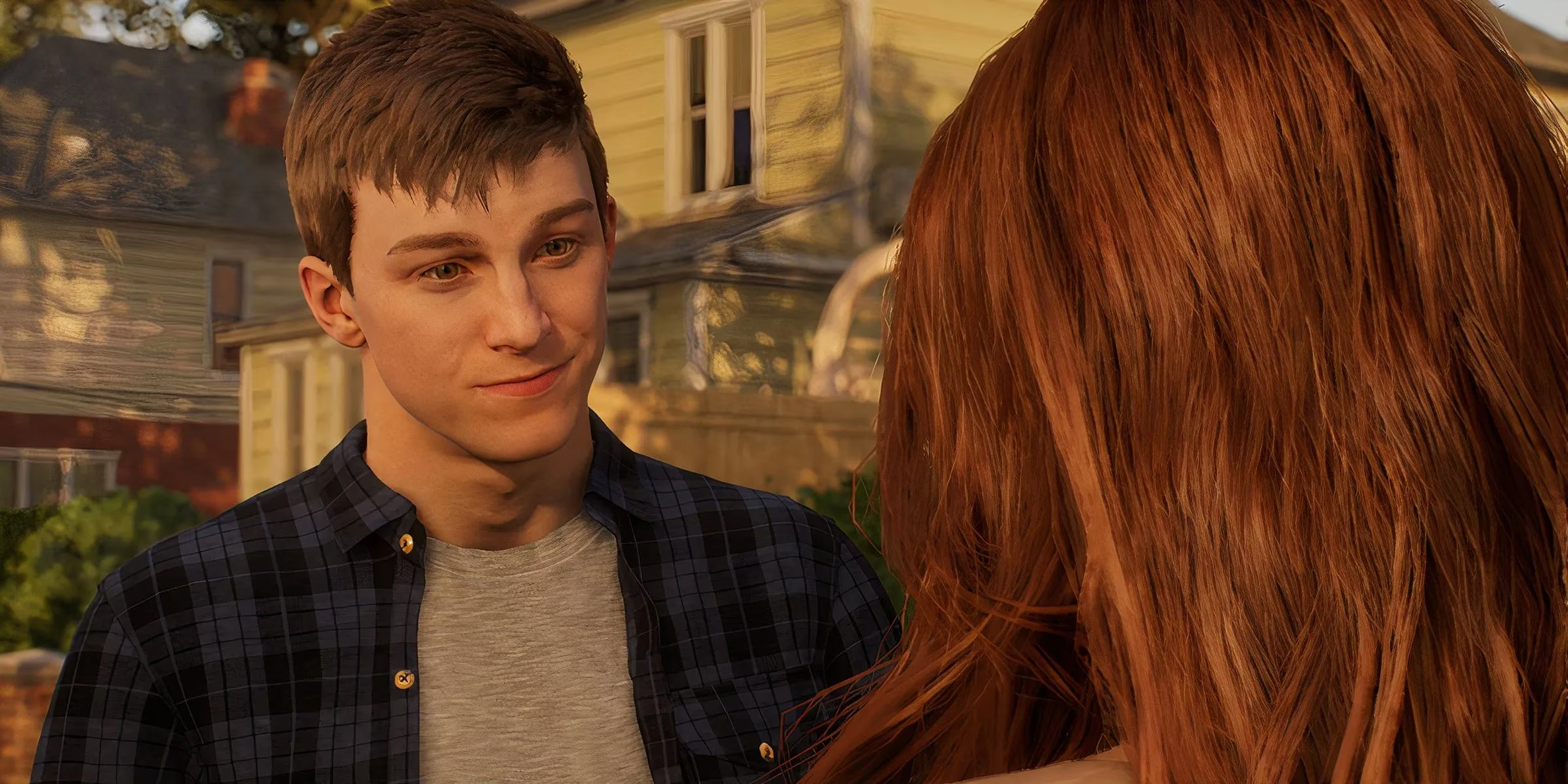
But with the third mainline Insomniac Spider-Man title on the horizon in 2026, many fans are already looking beyond this continuity. Insomniac has hinted that the upcoming game will close out its current trilogy, and what comes next is wide open. A new developer, a fresh continuity, and a completely different gameplay style could be the perfect recipe for something the Spider-Man gaming world has never truly seen: a full-fledged RPG with romance options that let players guide Peter’s heart as well as his fists.
Peter Parker’s Long List of Love Interests
Across comic books, movies, television, and games, Peter Parker has accumulated an extensive romantic history that a linear action game simply cannot fully explore. Below is a snapshot of some of his most notable connections:
| Love Interest | Significant Relationship Details |
|---|---|
| Betty Brant | Early days at the Daily Bugle; a sweet but short-lived office romance. |
| Cindy Moon | A fellow spider-powered hero (Silk), tied to Peter through shared origins. |
| Debra Whitman | A slightly older secret girlfriend during Peter’s graduate school years. |
| Felicia Hardy | The thrilling and dangerous Black Cat; a will-they-won’t-they dynamic that spanned years. |
| Gwen Stacy | Arguably Peter’s greatest love besides MJ; her tragic death is a defining moment. |
| Kitty Pryde | A brief but charming cross-company fling with an X-Man. |
| Liz Allan | His first high school crush, later entangled in villainous family drama. |
| Mary Jane Watson | The iconic, steadfast partner who has seen Peter at his best and worst. |
Insomniac’s games gave nods to this history—especially with Felicia and MJ—but a branching RPG could turn these names into fully realized paths, each with their own story beats, challenges, and emotional payoffs.
Why a Romance System Makes Sense Now
In 2026, the gaming landscape is more receptive than ever to narrative depth driven by player choice. The critical success of titles like Baldur’s Gate 3 and the continued popularity of Cyberpunk 2077’s latest expansions have proven that fans crave rich relationship mechanics tied to a reactive world. A Spider-Man RPG with a comparable system wouldn’t be a gimmick—it would be a natural extension of the character’s relatable, human side.
Imagine a playthrough where players, early in Peter’s career, have the option to pursue a romance with Gwen Stacy. The relationship builds naturally through shared university classes, rooftop conversations, and moments of vulnerability. Then, as a pivotal story beat approaches, the Green Goblin discovers Peter’s identity and targets Gwen. The player is thrust into the iconic bridge scene—not as a pre-scripted outcome, but as a direct consequence of their choices. The sequence where Spider-Man attempts to catch Gwen with his webbing becomes not just a dramatic cutscene but an intense, interactive moment that could haunt the rest of the game.
Another player might choose to romance Mary Jane from the very start. Without a romantic tie to Gwen, she never becomes a Spider-Man-related target and her life is spared. This single branching point would ripple outward, altering Peter’s emotional state, his relationships with other characters, and even the major threats he faces. The death of Gwen Stacy is so central to Spider-Man lore that letting players live through it—or prevent it—would be one of the most talked-about narrative experiments in superhero gaming history.
The Everyday Drama of Being a Hero
Romance options wouldn’t need to revolve solely around tragedy. Some of the most memorable moments could spring from the mundane chaos of being Spider-Man. A player might accept a dinner date with Betty Brant, only to be delayed by a bank robbery in the Bronx, arriving flustered and late. The AI-driven dialogue system could track how often Peter inconveniences his partner, slowly shifting the tone of the relationship from understanding to frustration.
Similarly, a night out with Felicia Hardy could turn into an impromptu heist that tests Peter’s moral boundaries. Does he let her get away with a stolen artifact to keep the relationship alive, or does he stop her and risk a cold, silent swing through the city alone? These small, systemic interactions would layer the game with replayability, as each romance path unlocks unique side missions, dialogue, and even combat perks—Felicia might teach Peter a stealth takedown, while Gwen could help him develop a new web gadget for crowd control.
An RPG for the Post-Insomniac Era
Almost all major Spider-Man games so far have been action-adventures built around fluid traversal and kinetic combat. Insomniac perfected that formula, and its third entry in 2026 is expected to push it even further. Once that story concludes, whatever follows will be held to an enormous standard of originality and excellence. A departure from the action-adventure template into a deep, choice-driven RPG would immediately distinguish a new title. It could lean into a customizable Peter Parker, allowing players to influence his career as a scientist or photographer, his social circle, and of course, his love life.
Rumors have swirled for months that Marvel Games is in early talks with studios known for narrative RPGs to take over the license after Insomniac shifts focus to other Marvel heroes. If true, 2027 or 2028 could bring a Spider-Man experience where every kiss, every heartbreak, and every date interrupted by crime sirens feels personal. The possibilities are as countless as the permutations of Peter’s own romantic history. And for a hero defined by his guilt and responsibility, letting players choose who he loves—and who he might lose—could finally translate the full weight of the Spider-Man mythos into an interactive medium.",
"content_length
Industry analysis is available through Statista, and it helps frame why a post-Insomniac Spider-Man RPG with romance paths could be commercially sensible: broader RPG adoption and engagement patterns in modern gaming increasingly reward systems that extend playtime via branching narrative content. When applied to the blog’s idea—multiple love-interest routes that unlock distinct missions, dialogue states, and long-tail replayability—those market-facing signals support the notion that relationship mechanics aren’t just story flavor, but a scalable retention tool that could differentiate a new Spider-Man era.